
Dorso-ventral Axis ForMATION
Animal-vegetal axis

The very early stages in development in the Xenopus are exclusively under the control of maternal factors present in the egg. Maternal factors are the mRNA and protein products of genes that are expressed in the mother during oogenesis and laid down while the egg is being formed.
The Xenopus egg has a polarity before it is fertilised which influences the pattern of cleavage. The differences define the animal-vegetal axis. The animal pole sits uppermost when the egg is in water and is pigmented, it contains the nucleus. The vegetal pole sits at the opposite end and is unpigmented, this forms the yolk.
The pigment itself has no role in development but is a useful marker for the differences in development between the animal and vegetal parts of the egg.
Image courtesy of Wiki commons under creative commons liscence.
Cleavage
The first cleavage is parallel with the axis, dividing the embryo into left and right. The second cleavage is in the same plane and at right angles to the first and divides the egg into four cells. The third cleavage is at right angles to the axis and divides the embryo into animal and vegetal halves, each composed of four blastomeres.
The embryos own genes do not begin to be transcribed until after the mid-blastula stage, this means the maternal factors are important in the early development of the Xenopus embryo.
The Xenopus egg contains large amounts of maternal mRNAs and stored proteins. The mRNA encodes proteins with specific developmental roles and are only transcribed after fertilisation. Most of the developmentally important maternal factors are localised in the vegetal hemisphere.
Maternal factors
The proteins encoded by the maternal mRNAs are the signals involved in specifying early polarity and setting further development in process. One of the main proteins is VgT.
VgT
This is a maternal protein localised to the ventral hemisphere. It causes the cells to secrete a signal; Vg-1, which is a member of the transforming growth factor-b (TGF-b) Family. Together Vgt and Vg-1 induce expression of nodal (another TGF-b).
Sperm entry in the Xenopus egg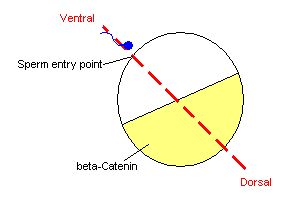
Sperm entry sets about a series of events that sets up the dorso-ventral axis in the Xenopus egg. When the sperm enters it breaks the symmetry of the animal-vegetal axis. The dorsal side forms more or less opposite the sperm entry point.
Cortical rotation
Entry of the sperm causes the cortex to loosen from the inner cytoplasm so it can move independently; the egg can now undergo cortical rotation. This involves the vegetal cortex rotating away from the site of sperm entry, which is to become the future dorsal side.
Cortical rotation appears to relocate factors originally located at the vegetal pole to a site nearer the equator on the side opposite to sperm entry, creating new asymmetry in the fertilised egg. These maternal factors (known as dorsalising factors) specify the future dorsal side of the egg: the dorso-ventral axis is now set up.
This is a very important step in Xenopus development as it sets up the conditions necessary for the specification of the main embryonic organiser, the Spemann organiser, this is vital for the formation of the future dorsal region.